
How to Specify H Beam for International Steel Projects
A practical guide for international buyers and engineers: understanding H beam specifications, global standards, size selection, tolerances, surface treatment, quality documentation, and common procurement pitfalls.
Introduction
H beams (wide-flange beams) are the backbone of modern steel-frame construction. Used in everything from high-rise buildings and industrial plants to bridges and offshore platforms, these hot-rolled structural sections carry primary loads and define the structural grid. For international procurement teams and consulting engineers, specifying H beams correctly — across different standards, mill practices, and quality regimes — is one of the most consequential decisions on the bill of materials.
This guide walks through what international buyers and engineers need to know: standard designations, size selection, tolerance expectations, surface treatment options, quality documentation, shipping considerations, and the most common mistakes we see in cross-border procurement.
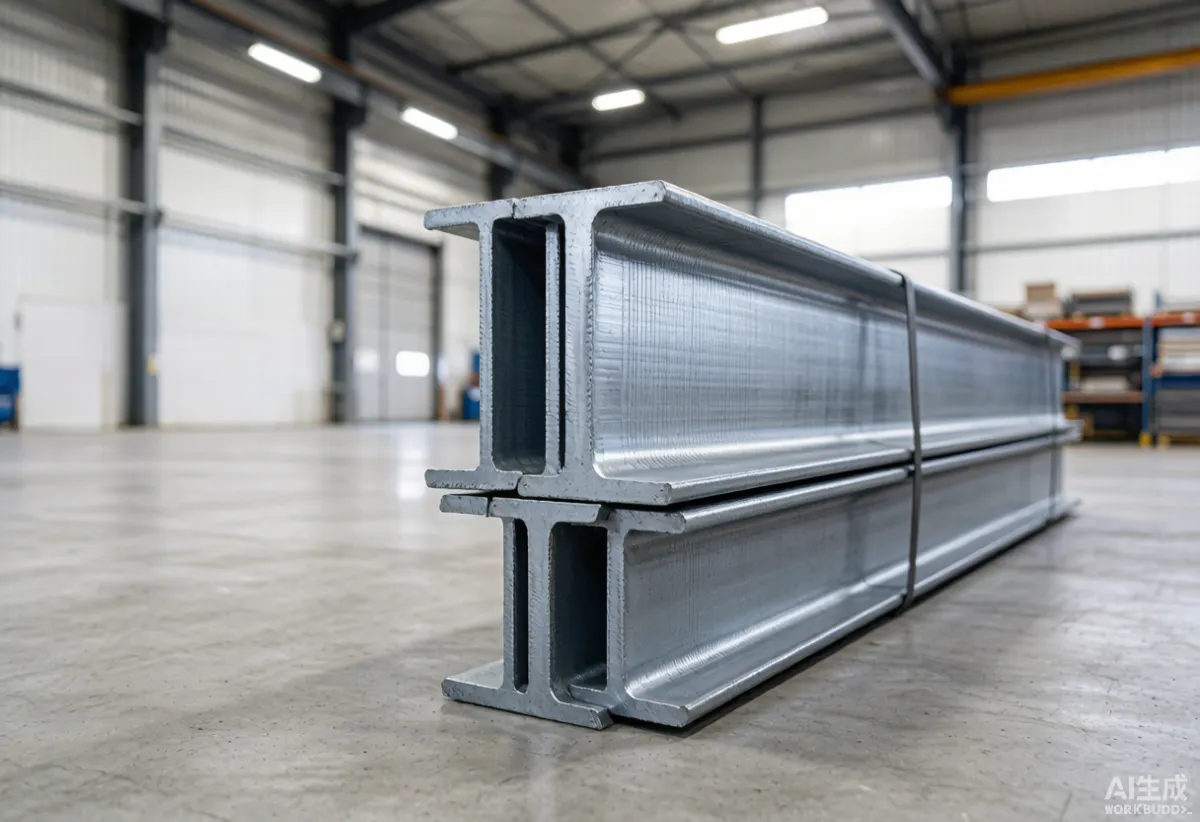
H Beam wide-flange sections stacked at a SHEDAR partner mill yard. Sections shown are standard hot-rolled HB series in Q235B and Q355B grades, available in lengths from 6 m to 18 m.
Understanding H Beam Designations Across Standards
The first point of confusion in international procurement is that different standards name the same section differently. Knowing the equivalent designation under your project's governing code prevents ordering the wrong material.
- GB/T 11263 (China) — HW (wide flange), HM (medium flange), HN (narrow flange). Example: HW300×300×10×15 denotes a 300 mm deep section with a 300 mm flange, 10 mm web and 15 mm flange.
- EN 10034 (Europe) — HEA (light), HEB (standard), HEM (heavy) series. These are the most commonly referenced European H beam profiles, with HEB being the workhorse for building frames.
- ASTM A6/A6M (USA) — W-shapes. Example: W12×65 denotes a nominal 12-inch deep wide-flange beam weighing 65 lb/ft. The actual depth differs slightly from the nominal designation.
- JIS G3192 (Japan) — H-shapes with metric depth × width × web × flange naming, closely aligned with the Chinese GB system but with slightly different rolling tolerances.
When sourcing from Chinese mills (which is increasingly common for international projects due to competitive pricing and large production capacity), your supplier should be able to supply against any of these standards. A cross-reference table between GB, EN, and ASTM equivalents is essential for bid evaluation.
Key Dimensional Parameters for Specification
When writing an H beam specification or reviewing a supplier's offer, these are the parameters that matter:
- Section Height (H) — 100 mm to 1,100 mm is the typical range for hot-rolled H beams from Chinese mills. Sections above 900 mm may have longer mill lead times.
- Flange Width (B) — For wide-flange sections, the flange width is equal or nearly equal to the section height. Narrow-flange beams (I-beams) have narrower flanges and should not be confused with H beams.
- Web Thickness (t1) — Typically 5 mm to 21 mm. The web governs shear capacity. Thicker webs are required for high-shear zones in building frames.
- Flange Thickness (t2) — 7 mm to 40 mm. The flange governs bending moment capacity. Grade and thickness together determine the available section modulus.
- Length — Standard mill lengths are 6 m, 9 m, 12 m, and 18 m. Custom lengths up to 24 m are available on special mill order but require breakbulk or flat-rack shipping.
Always specify whether length tolerances follow the standard's default (typically +100 / -0 mm for GB) or a tighter project-specific requirement.
Dimensional Tolerances — What to Expect and What to Demand
Tolerances vary by standard and section size, but here are typical values for hot-rolled H beams per GB/T 11263 and EN 10034:
- Section height tolerance: ±2.0 mm for H ≤ 200 mm; ±3.0 mm for H 200–400 mm; ±4.0 mm for H > 400 mm
- Flange width tolerance: ±2.0 mm for B ≤ 200 mm; ±3.0 mm for B > 200 mm
- Web thickness tolerance: ±0.5 mm (target) — but note that hot-rolled web thickness has inherent variation due to the rolling process
- Straightness / camber: ≤ 0.2% of length
- End squareness: ≤ 1.6% of section height (per GB/T 11263)
For high-tolerance applications (e.g., architectural exposed steel), discuss tolerance expectations with your supplier before ordering. Chinese mills can deliver tighter tolerances on request but the specification must be agreed in the purchase contract, not assumed.
Steel Grades and Mechanical Properties
The grade you specify determines weldability, ductility, and load-carrying capacity. Common grades for international projects sourced from China include:
- Q235B — Chinese mild steel, yield strength 235 MPa. Widely used for general structural applications where high strength is not critical.
- Q355B — Chinese high-strength low-alloy (HSLA) steel, yield strength 355 MPa. The most commonly specified grade for building frames and bridges. Equivalent to S355JR under EN 10025-2.
- SS400 — Japanese standard mild steel. Common in Southeast Asian projects under JIS-based specifications.
- A36 — American standard structural steel with minimum 250 MPa yield. Widely specified in Middle Eastern and Latin American projects.
- A572 Gr.50 — American HSLA steel, 345 MPa yield. Common for bridges and heavy structures.
- S275JR / S355JR — European standard structural steels under EN 10025-2. S355JR maps closely to Q355B.
Key tip: Always specify whether Charpy impact testing is required (e.g., at 0°C, -20°C, or -40°C). Grades like Q355B have no mandatory Charpy requirement; Q355C/D/E add impact testing at progressively lower temperatures. The same applies to EN grades (JR = +20°C, J0 = 0°C, J2 = -20°C).
Surface Treatment Options
H beams typically leave the mill with a hot-rolled mill finish — a thin, dark oxide scale layer. For most structural applications buried in concrete or hidden behind cladding, this is sufficient. For exposed or corrosive environments, consider:
- Shot blasting — Removes mill scale to SA 2.5 cleanliness for paint/primer adhesion. Commonly specified for architectural exposed steel and bridge components.
- Shop primer — A temporary anti-corrosion coating applied after shot blasting. Typical thickness 15–25 μm. Provides 3–6 months of protection during transit and site storage.
- Hot-dip galvanizing — For high-corrosion environments (coastal, chemical plants). Requires the steel to be fabricated before galvanizing, as the zinc coating is damaged by welding.
- Anti-rust oil — A light oil coating for short-term transit protection. Cheapest option, suitable when steel will be blasted and painted on site.
For international shipping, we recommend at minimum a shop primer or anti-rust oil application, as unprotected mill-scale steel can develop surface rust during ocean transit, particularly in humid conditions.
Quality Documentation — What to Require
A complete quality documentation package protects both the buyer and the project. For each shipment, require:
- Mill Test Certificate (MTC) per EN 10204 3.1 — The minimum standard for international steel trade. Confirms chemical composition, yield strength, tensile strength, and elongation for each heat/lot.
- Dimensional inspection report — Per-lot measurements of section height, flange width, web/flange thickness, and straightness. Some mills provide this automatically; others require explicit request.
- Third-party inspection (optional but recommended) — SGS, Bureau Veritas (BV), or TUV inspection at the mill or loading port. Adds approximately USD 2–5 per ton but catches non-conformances before shipment.
- Loading photographs — Document container/breakbulk loading with bundle tags visible. Essential for claims handling if cargo arrives damaged.
One of the most common procurement pitfalls is accepting a generic mill certificate that does not reference the project heat numbers. Always cross-check that the MTC heat numbers match the bundle tags on your shipment.
Shipping and Logistics Considerations
H beams present unique shipping challenges due to their length and weight concentration:
- Container loading: 20'GP holds ~20–22 tonnes; 40'GP holds ~24–26 tonnes; 40'HQ holds ~26–28 tonnes. Sections longer than 11.8 m require a 40' container or breakbulk.
- Breakbulk / flat-rack: Required for sections exceeding 12 m length. Higher freight cost but necessary for long-span beams.
- Bundle weight: Typically 2–3 tonnes per bundle, secured with 4–6 metal straps. Lighter bundles (1–2 t) available for manual offloading sites.
- Mixed loading: In a single project order, H beams can be mixed with I-beams, channels, and angles in the same container to optimize freight cost.
Always confirm the destination port's offloading capability — some smaller ports lack the crane capacity for heavy breakbulk steel sections.
Common Procurement Pitfalls and How to Avoid Them
Based on SHEDAR Steel's experience in international H beam supply, these are the most frequent issues and how to prevent them:
- Standard confusion: The buyer orders "HEB 300" but the mill supplies GB HM 300, which has slightly different flange thickness. Solution: Always specify the standard explicitly in the purchase order and reference the dimension table.
- Grade mismatch: Ordering Q235B when the project requires Q355B (or S275 when S355 is needed). The section looks the same but has 30–40% less load capacity. Solution: Include the governing design code in the RFQ.
- No Charpy specification: The steel arrives without impact testing, but the project is in a cold climate requiring guaranteed toughness at -20°C. Solution: Specify Charpy test temperature and minimum absorbed energy in the purchase order.
- Length waste: Ordering standard 12 m sections for a project that needs 5.8 m cut lengths, resulting in 0.4 m offcuts per piece (3.3% scrap). Solution: Discuss optimized mill lengths with your supplier — custom lengths can reduce waste on large-volume orders.
- No third-party inspection: Trusting a mill certificate without independent verification. On large or critical orders, the cost of third-party inspection is negligible compared to the cost of receiving non-conforming steel.
- Shipping damage: Loose bundles that shift during ocean transit, causing surface damage or bent flanges. Solution: Require photograph-documented loading with proper dunnage and strapping as a contractual condition.
How SHEDAR Steel Supports Your H Beam Procurement
At SHEDAR Steel, we help international buyers navigate these complexities from inquiry to delivery. Our approach includes:
- Standard cross-reference: We provide dimension equivalence tables between GB, EN, ASTM, and JIS sections so you know exactly what you're getting.
- Mill selection: We match your order to the right mill based on section size, grade, tolerance requirements, and project certification needs — not just the lowest price.
- Quality documentation: Every shipment includes MTC per EN 10204 3.1, dimensional reports, and loading photographs. Third-party inspection (SGS/BV/TUV) arranged on request.
- Logistics planning: Container loading plans optimized for weight, volume, and offloading constraints at the destination port.
- Responsive support: We reply to inquiries within 12 working hours with a quotation covering grade, size, quantity, delivery terms (FOB/CFR/CIF), and lead time.
If you're preparing an inquiry for a structural steel package, contact our team with the section list, grades, tonnage, and destination port. We'll provide a tailored quotation with all documentation requirements built in.
Related Products
Explore our structural steel product range:
Need H Beam or Other Structural Steel?
Tell us the grade, size, quantity, and destination port. We respond within 12 working hours with a quotation, lead time, and delivery terms tailored to your project.